
UAE / Latest News
Al Ain Science Festival Opens With 615 Students and 158 Projects
The eighth National Science, Technology and Innovation Festival opened at ADNEC Centre Al Ain on 10 November 2026. Organisers reported 615 student participants and 158 projects, alongside a family programme and competitions from kindergarten through university level.
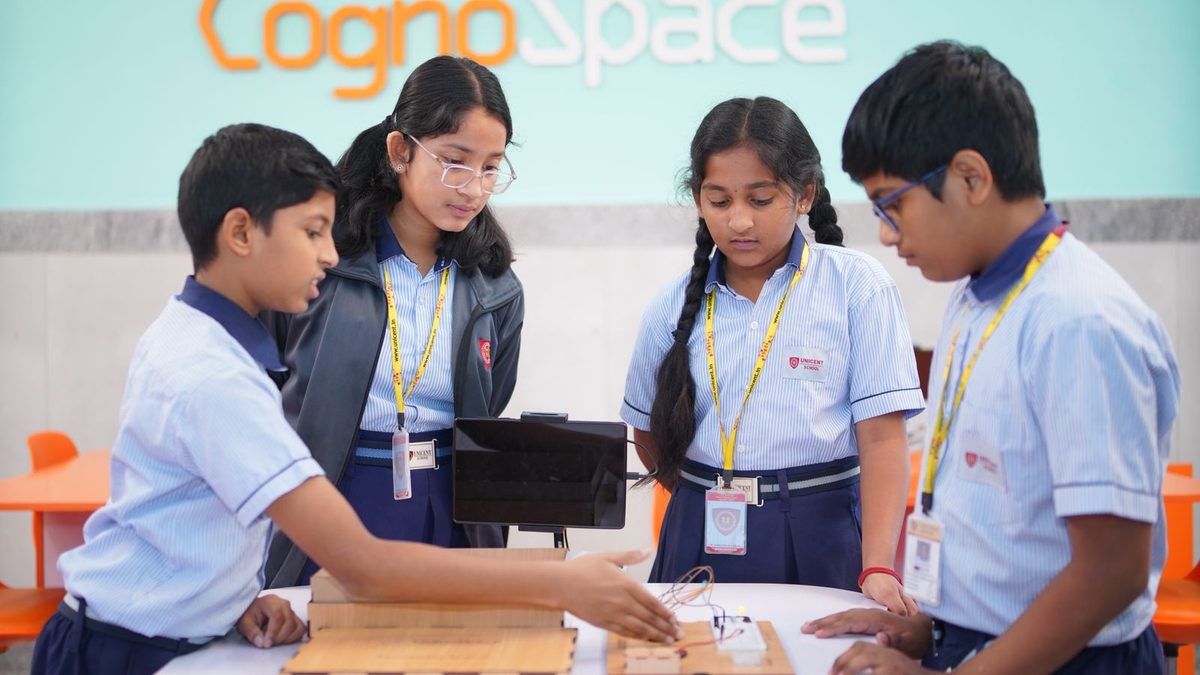
A four-day meeting of schools and researchers
The Ministry of Education is organising the festival with the Advanced Technology Research Council, with activities continuing through 13 November. Education Minister Sarah Al Amiri and Minister of State for Youth Affairs Sultan Al Neyadi attended the opening. The programme places research projects, challenge-based competitions, a scientific conference and family activities in the same venue. The structure lets school groups see work from older students and lets universities see how younger pupils begin asking and testing scientific questions.
The attendance figures describe different units. The 615 figure counts students across the festival, while 158 counts the research and applied projects reported at the opening. Some projects are presented by teams, and the youngest entrants have their own competition structure. For a school following the event, the headline numbers establish the scale of participation. The competition details show what pupils are actually being asked to do at each stage, from communicating an idea with a team to discussing a research method with judges.
The school research competition
The Emirates Young Scientist Competition received 2,651 registrations from Grades 5 to 12, and 100 projects advanced to the final stage. Students compete in two grade bands, Grades 5 to 8 and Grades 9 to 12. The subject categories cover technology, biological and ecological sciences, chemical, physical and mathematical sciences, and behavioural and social sciences. This gives a visitor several ways to understand the term research. An investigation can involve a physical experiment, a design, data about behaviour or an observation of a living system.
The opening report says the final-stage assessment is aligned with criteria used at the Regeneron International Science and Engineering Fair. For students presenting in Al Ain, a useful part of that experience is explaining how they arrived at an answer. Someone looking at a display can ask what prompted the question, which variables the student could control, and how the team checked its observations. Those questions help a visitor understand the work represented by a poster, a model or a demonstration.
University teams take on defined challenges
The Advanced Technology Pioneers Competition attracted 707 applications from university students and recent graduates. The organisers selected 210 participants in 58 teams to work on prototypes or simulations addressing challenges set by the Department of Culture and Tourism – Abu Dhabi, EDGE Group and Emirates Nuclear Energy Corporation. A brief from a named organisation gives teams a problem they can examine from several directions. It can raise questions about the people who would use a solution, the conditions it must operate in and the evidence needed to assess it.
At an exhibition stand, a prototype lets a team show what it has built and explain the decisions behind it. A simulation lets it describe the conditions it represented and where its assumptions might change the outcome. Both formats give judges something concrete to examine. Visitors can ask what the team learned during testing, whether that changed the design, and which question it would investigate with more time. The answers can reveal progress that a display board’s short description has limited room to capture.
Younger pupils have their own format
The Junior Innovators Challenge received 1,402 entries and selected 150 finalists. Its groups cover kindergarten, Grades 1 and 2, and Grades 3 and 4, with 50 pupils selected in each. Activities include individual and team challenges. The published assessment areas include communication, teamwork and adaptability as well as creative thinking and problem-solving. In those age groups, an adult can pay attention to how a child describes an attempt, listens to a partner and tries again when a first idea produces an unexpected result.
The wider programme offers 80 sessions and workshops across the conference and family activities, according to WAM. Themes include how technologies have developed, human decision-making as AI spreads, and applications of robotics. The programme also connects cultural identity and sustainability. A family can select one session for a shared visit and give each person a chance to discuss something they observed. A school group can use the same approach by agreeing on a question before entering and comparing the answers afterward.
Visiting during the remaining days
ADNEC Centre Al Ain lists the festival through Friday, 13 November. The venue page provides event timings, and the organisers plan to announce competition winners at the closing ceremony. Families and schools can use the venue listing alongside any session information from the organisers when arranging arrival. Competition presentations, judging and family workshops serve different audiences, so the session schedule matters for a group that wants to see a particular age category or activity.
The range of work on display also gives a teacher material for a later lesson. Students can describe a project they saw, identify the evidence its team used and suggest a way to check one claim. A younger pupil might sketch a simple observation and explain it aloud. Such exercises connect the exhibition to work that can continue in a classroom or at home after the judging. They also give students who attend as visitors a way to practise the habits demonstrated by the people presenting.
Gabriel Nicolaev – CyGuru
Gabriel Nicolaev – CyGuru
Sources & further reading
WAM opening report and competition figures
ADNEC Centre Al Ain festival listing