
Kuwait / Explore
A Better Tareq Rajab Museum Visit: Follow Objects, Materials and Arabic Script Across Two Locations
Tareq Rajab’s collections in Jabriya reward a visit built around a few clear questions rather than an attempt to see everything. The original museum and the nearby calligraphy museum offer related but distinct ways to read objects, making, writing and cultural exchange.
Start by understanding the two places
The first useful decision is to treat the Tareq Rajab museums as two nearby locations rather than one building with interchangeable names. The original museum is in Jabriya, Block 12, Street 5, Building 22; the Museum of Islamic Calligraphy is in the same block on Street 1, Building 2. The museum’s official website explains the distinction and states that the same ticket can be used at both. Knowing which place you are approaching prevents a simple logistical mistake from consuming the attention intended for the collections.
The original museum was founded in 1980 by Tareq and Jehan Rajab. Its collections include manuscripts, ceramics, glass, metalwork, jewellery, costumes and musical instruments. The calligraphy museum provides a different emphasis, following Arabic script across several media. These are related perspectives, but the visitor need not force them into one exhaustive tour. Begin with a question that interests your group and let the two locations offer different answers. The goal is a visit that produces understanding, rather than the satisfaction of having walked past every available display.
Choose an object question before choosing a route
A productive starting question is what an object was made to do. A vessel, ornament or instrument can be appreciated visually while also being considered as something designed for use, display or communication. The question directs attention to scale, shape and material before the visitor reaches for a broad historical conclusion. It does not require expert knowledge. Nor does it allow a viewer to invent an object’s origin or function when the label has not established it. Observation comes first, supported by the museum’s information.
The second question is what choices the maker had to resolve. Consider how decoration fits the object’s shape or how different parts relate to each other. These are viewing prompts, not claims that every display provides a complete technical account of production. When a label answers the question, use it. When it does not, preserve the uncertainty rather than treating a confident guess as a discovery. A small number of well-observed objects can teach more than a long list of names that the visitor cannot later connect to anything actually seen.
Compare materials without turning differences into rankings
The original museum’s range makes comparison possible: glass, ceramics, metalwork and jewellery invite the visitor to notice how the same broad desire for form or decoration can appear in different materials. Choose two objects that hold your attention and ask what changes between them. Do not assume that a more ornate piece is automatically more important or that a precious material tells the entire social story. The museum’s collection is broader than any simple ranking of objects by visible expense, size or visual impact.
For a family or mixed-interest group, this creates a way to talk without requiring everyone to enjoy the same display. One person may notice shape, another colour, another a written element. Each observation can be specific and testable against the object rather than a contest over who knows the most history. The visitor should distinguish personal preference from the museum’s documented account. Saying that an object draws your attention is different from claiming that its maker intended a particular reaction, especially when the available information does not say so.
Read script as more than words on a page
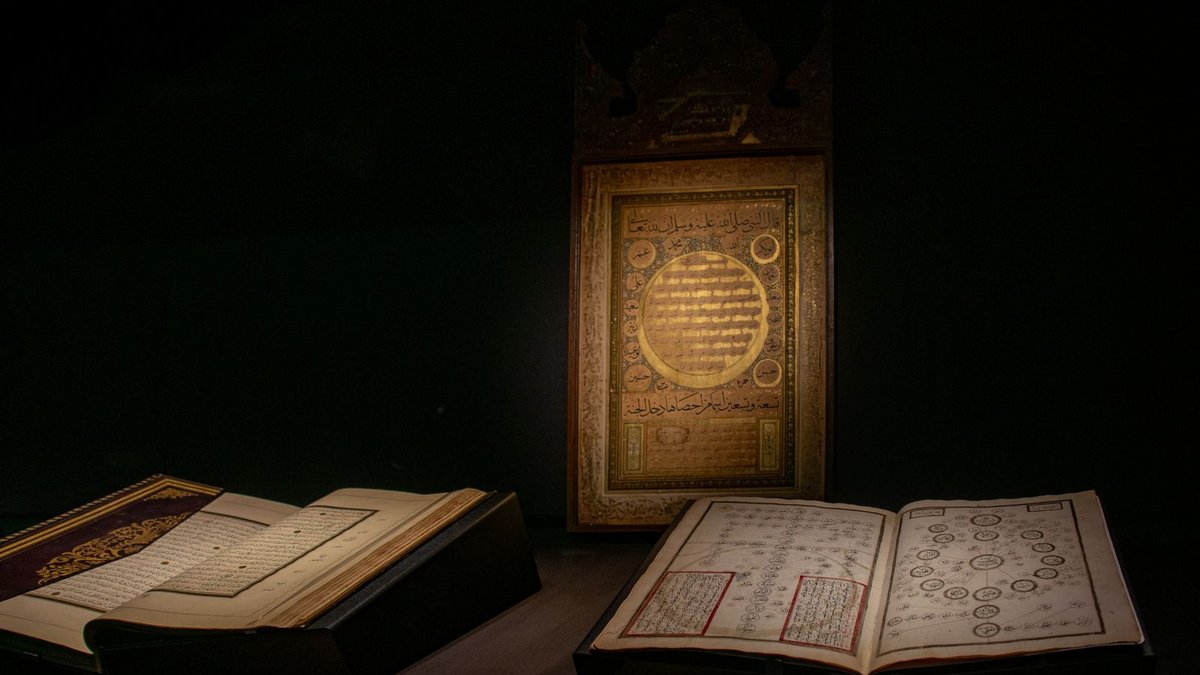
The nearby calligraphy museum broadens the encounter with Arabic script beyond a single format. Its official introduction describes writing presented through manuscripts and other media, including decorated objects. That provides a useful change of question: what happens when writing is also part of an object’s visual structure? A visitor who reads Arabic may engage with the text, while a visitor who does not can still observe proportion, spacing and the relationship between writing and the surface carrying it. Both approaches benefit from the accompanying explanation.
The important boundary is between noticing visual features and claiming a reading or interpretation that has not been verified. Do not turn an unfamiliar inscription into a decorative pattern with no meaning, but do not pretend to translate it either. Ask what the museum identifies and keep that evidence separate from your response. The encounter can be valuable at several levels: language, form, material and context. The second museum is therefore not merely an additional stop; it can change the way the visitor looks back at writing encountered among objects in the first.
Use the collections to widen the idea of Kuwait
A museum located in Kuwait does not need to contain only objects originating within Kuwait to be meaningful to a visitor here. The Rajabs’ collection grew through an interest in art from across Arab and Islamic worlds, and the official museum account emphasises preservation and education. Its local significance includes the decision to collect, care for and make that material available in Jabriya. This is a different story from assuming every displayed object represents a single national tradition or that the collection can be read as a complete history of Kuwait.
That wider perspective is particularly useful for residents who know the country chiefly through work, shopping and daily travel. The visit creates an opportunity to encounter Kuwait as a place where cultural material from many regions is studied and shared. This is an interpretation of the institution’s role, not a claim that the collection alone explains every connection between those regions. The labels and the museum’s own account should lead any precise geographical or historical statement. The visitor’s role is to notice connections without flattening the differences that make the objects informative.
Build the practical visit around the people attending
The official website currently lists Saturday to Thursday opening periods of 9am–1pm and 4:30pm–8:30pm, with Friday hours of 9am–1pm. It lists admission at KD3 for adults and KD1.5 for visitors under 18, with children under six admitted free. Verify current arrangements before travelling, especially if the visit depends on an exact opening time. These published details are practical information, not a guarantee against a later change. Keep the two addresses available so that a plan to visit both does not become a search for the wrong entrance.
Choose the scope according to attention and mobility rather than assuming a group will benefit from the longest possible itinerary. The website information reviewed does not establish every access, photography or group-booking arrangement. Ask the museum directly about any requirement that matters to your party. For children, a small object-finding question may be more engaging than a demand to memorise dates. For adults with different interests, agreeing on one shared comparison can keep the visit connected while allowing each person time to follow the display that interests them most.
Leave with a comparison you can explain
A useful final exercise is to choose one observation from each location and explain the link between them in plain language. It might concern the role of writing, a material choice or the way an object communicates status or purpose, provided the labels support the particular claim. The point is not to produce an impressive interpretation. It is to distinguish what you saw, what you learned from the museum and what remains your own question. That separation gives the experience substance without pretending a short visit makes the visitor an expert.
The most rewarding version of this Jabriya outing is therefore selective and connected. Find the correct location, verify current visiting arrangements, give a few objects sustained attention and let the calligraphy museum alter the questions asked of the original collection. There is no need to manufacture a single grand story from everything on display. A clear comparison, a newly understood object and a question worth returning to can be a stronger result than a hurried circuit of both buildings. The museums then become places to revisit, rather than places crossed off a list after one pass. Gabriel Nicolaev – CyGuru
Gabriel Nicolaev – CyGuru
Sources & further reading
Tareq Rajab Museum: visitor information
Tareq Rajab Museum: original collection