
UAE / Explore
ISEA2026 Sets Out Its Online Academic Programme as Dubai Prepares for Ten Days of Electronic Art
Dubai Culture’s 2 November programme announcement connects a paid online research symposium with a separate, free registered artistic programme across Dubai. With the opening set for 6 November, the distinction matters for students, artists and visitors planning what they can actually attend.
A programme announcement with two different audiences
Dubai Culture unveiled details of ISEA2026’s Online Academic Programme on 2 November, ahead of the symposium’s opening on 6 November. Organised with Zayed University, the 31st International Symposium on Electronic/Emerging Art examines the meeting of artistic practice, scientific research and technology. Its theme is ELYAH: Constellating Place, Data, and Identity.
The immediate practical point is that this is not a single ticketed exhibition in one building. It combines online academic activity with an in-person artistic programme at venues across Dubai. Someone seeking research presentations has a different attendance decision from a resident planning an evening with an installation. Understanding the two formats helps prevent the programme’s scale and terminology from obscuring the information people need before they register or travel.
The dates need to be read at programme level
The overall symposium runs from 6 to 15 November. The official online programme lists its academic activity from 6 to 14 November, with workshops and special programmes scheduled for 6–9 November and the core academic programme on 10–14 November. A broad event date therefore does not establish that every session or venue operates throughout the entire period.
For prospective attendees, the sensible next step is to select individual sessions and consult their detailed listings. Save the date, timing and access instructions for each choice rather than relying on a poster for the whole symposium. That approach is particularly important for remote participants joining from outside the UAE, who should verify the schedule’s stated time zone and convert it carefully before arranging work or study commitments.
Online access and live registration serve different purposes
The official registration page lists the Online Academic Programme at AED180 for a standard ticket and AED90 for a student ticket booked with a valid university email address. The in-person Artistic Programme is free to attend but requires registration. Prices and registration conditions are reported here as shown by the organisers when checked on 3 November.
A paid academic ticket should not be confused with a generic admission pass that removes the need to read venue-specific instructions. Likewise, free registration does not mean an online academic ticket is included. Attendees should follow the organisers’ official registration route and retain confirmation details. For groups, schools or people with accessibility questions, resolving requirements in advance is more efficient than assuming every venue and programme component uses identical arrangements.
Why the academic strand changes the experience of digital art
A digital artwork can be compelling before a visitor understands how it was made. An academic programme creates room for a different kind of engagement: asking what choices shaped the work, which assumptions its systems contain and how its effects are interpreted. That layer can matter as much as the screen, sound or projection visible to an audience.
Our analysis is that the most useful conversations happen when technical and cultural explanations meet. A programmer may focus on the mechanism that produces an image, while an artist or historian asks what the image does to memory, language or authorship. Neither explanation is complete on its own. A symposium offers a structured opportunity to compare them without reducing the work to either a software demonstration or an unexplained spectacle.
Four themes offer a way to choose rather than consume everything
The official programme organises discussion around Celestial Dialogues, Charting Constellations, Eco-Tech Futures and Starlinked Worlds. Broadly, those strands address cosmic imagination, digital geographies, ecological responsibility and networked or AI-shaped experience. They provide a useful map for an event whose interdisciplinary scope could otherwise feel overwhelming.
A newcomer does not need to follow every strand. Choosing one question across several sessions can produce a more coherent experience than sampling many unrelated presentations. A student interested in place might compare how artists represent a city, preserve a memory and interpret a dataset. A practitioner concerned with environmental impact might follow work linking scientific observation with material or computational choices. Those are suggested ways to navigate the programme, not promised outcomes for particular sessions.
Heritage raises questions about authority as well as technique
WAM’s programme report describes discussion of cultural memory, storytelling and new approaches to presenting heritage. These topics have a particular relevance in a city hosting international artists and researchers while also seeking to support creative work rooted in local culture. The challenge extends beyond making an old object visually impressive with a new tool.
Our interpretation is that digital heritage should invite questions about who selects the material, who has permission to reinterpret it and which voices are absent from the resulting experience. A technically polished reconstruction may still contain uncertain assumptions. Distinguishing documented history from speculation allows audiences to appreciate creative invention without confusing it with an authoritative record. For students and curators, that distinction is a useful lens to bring to talks and exhibitions alike.
AI art becomes more interesting when the process is visible
The announced programme also includes discussion of artificial intelligence and identity. The significance is not simply that artists are using fashionable tools. Generative systems raise concrete questions about selection, authorship, training material and the relationship between an initial instruction and a finished work.
A useful audience question is what the artist has chosen to expose about that process. Can a viewer understand the human decisions involved, the role of a model and the reason for keeping a particular result? This is an analytical framework, not an allegation about any ISEA contributor. It can move a discussion beyond whether an image looks impressive toward how a work produces meaning. The same questions are relevant to educators assessing student practice and institutions deciding how to describe technologically mediated work.
Environmental responsibility includes the method of making
Eco-Tech Futures gives the programme an explicit environmental dimension. For audiences, that creates an opportunity to ask whether a work’s ecological subject is reflected in its production choices. Representing a landscape and examining the resources used to represent it are related but separate activities.
Our analysis is that meaningful scrutiny can include the equipment involved, the lifespan of an installation, the treatment of materials and the explanation of computational choices. It should also distinguish an artist’s experiment from a verified scientific measurement. Art can generate attention and new questions without needing to impersonate a technical report. A productive exchange allows creative exploration and scientific evidence to retain their different strengths, rather than assuming that a work automatically proves every environmental claim associated with its subject.
The online format creates access and demands preparation
An entirely online academic strand allows participation without travelling to Dubai. That can make it more practical for students and practitioners elsewhere in the GCC to follow talks while maintaining existing commitments. It also shifts some responsibility to participants: reliable access, a workable viewing environment and an intentional choice of sessions matter.
The organisers state that recordings will be made available to ticket holders later. That is useful for planning, but it should not be treated as a promise of immediate replay after every session. Participants who particularly value live questions should prioritise the relevant session at its scheduled time. For a university group, a short discussion after a presentation may produce more educational value than leaving a long stream running in the background without a clear shared question.
An artwork visit and an academic session can inform each other
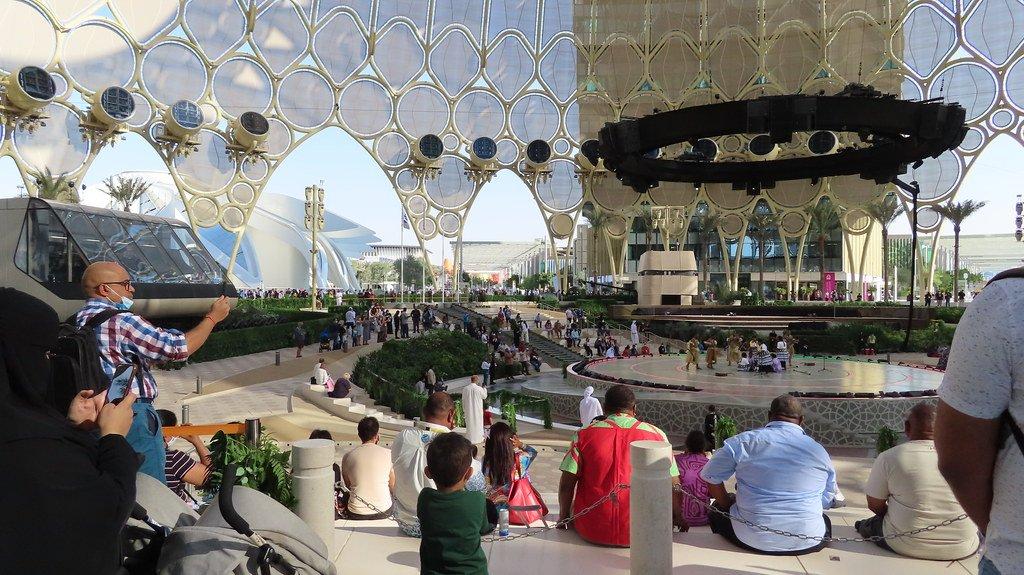
The in-person programme is distributed across Dubai, with WAM identifying venues including Al Wasl Dome, ARTE Museum and Theatre of Digital Art. These venue references do not mean the same work, timing or access arrangement applies everywhere. Visitors should use the official artistic programme and venue guidance to build a realistic route.
One useful strategy is to pair a small number of visits with an online theme. Seeing a work first can make a later discussion more concrete; hearing an artist explain a method can change what a viewer notices on a subsequent visit. This is a suggested approach to attendance, not a claim that the organisers have paired specific sessions and installations. Allowing time to reflect between encounters may be more rewarding than treating every venue as a box to complete.
What would make the symposium matter after closing day?
The opening programme is evidence of planned activity, not yet evidence of lasting collaborations or economic impact. Those outcomes can only be assessed later. Useful signs would include published research, continuing exchanges between participants, documented artistic methods and opportunities that remain accessible after the installations close.
For now, the news is that the online academic programme has been set out and registration routes are available before 6 November. The opportunity for audiences is to approach electronic art with greater curiosity and sharper questions. In a field where technical novelty can dominate attention, a detailed discussion of place, identity and responsibility can reveal what a work is actually trying to say. That is the strongest reason to read beyond the event headline before choosing how to take part.
Gabriel Nicolaev – CyGuru
Sources & further reading
WAM — Dubai Culture academic programme announcement, 2 November 2026
ISEA2026 — official online academic programme
ISEA2026 — official registration and ticket conditions
ISEA2026 — official frequently asked questions
Photograph source and licence review — Wikimedia Commons
Photo credit: Dennis Sylvester Hurd