
Oman / Explore
Omani coffee is a practice of hospitality: how to read the gathering beyond the cup
Qahwa becomes more meaningful when a visitor pays attention to the host, the rhythm of serving and the conversation around it. This cultural feature examines Omani coffee through living practice, shared heritage and respectful participation rather than a rigid performance of etiquette.
Start with the relationship
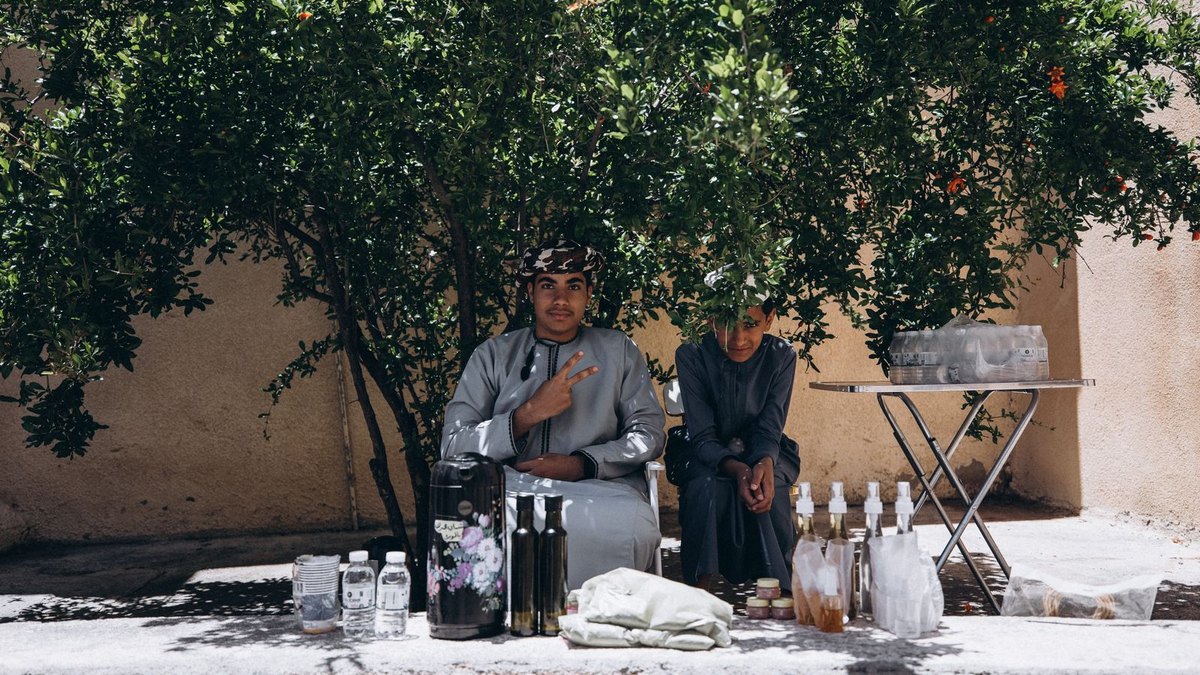
A cup of Omani coffee can be consumed quickly, but the practice around it asks for a different kind of attention. A visitor is entering a relationship between host, guest and gathering, not simply evaluating a beverage. The useful questions are ordinary: who is welcoming whom, how is the gathering arranged and what pace does the host establish? This feature offers an interpretive approach to hospitality in Oman. It does not claim that every household, region or occasion follows an identical script, nor does it turn a cultural practice into a test that a visitor must pass.
UNESCO identifies Arabic coffee as a symbol of generosity within a shared multinational heritage that includes Oman. Its description places serving and drinking within daily life, gatherings and intergenerational transmission. That framework is important because it locates the heritage in actions and relationships, not solely in an object or recipe. The analysis here starts from that distinction. A beautiful pot can represent the practice, but the practice continues through people making, serving, receiving and discussing coffee in circumstances that remain part of contemporary life.
Shared heritage is not a uniform recipe
The original UNESCO inscription in 2015 involved the United Arab Emirates, Saudi Arabia, Oman and Qatar; a later extension included Jordan in 2024. This history is useful for understanding the scale of the cultural recognition. It does not make every preparation method or local setting interchangeable. Shared heritage can contain variation, and a visitor should resist using one experience elsewhere in the region as a rule for interpreting every Omani gathering. The question is how the particular hosts practise hospitality, rather than whether they reproduce a visitor’s preconceived version.
A cultural encounter becomes thinner when it is reduced to a list of ingredients or a photograph of a cup. Flavour and presentation matter, but they do not explain why a host offers coffee at a particular moment or how a gathering makes room for conversation. Those meanings are best approached through observation and a respectful question when appropriate. The visitor need not invent a symbolic explanation for every gesture. Accepting that some details are simply the preference of a household is part of understanding living culture accurately.
Read etiquette as communication
UNESCO’s account describes conventions such as serving older people and guests first and the cup-shaking signal used to indicate that a drinker has finished. Such details are useful because they show etiquette functioning as communication. They should not be presented as a reason for a visitor to feel anxious about every movement. In an unfamiliar setting, watching the host and asking quietly is generally more informative than relying on a memorised internet checklist. This is a practical interpretive suggestion, not a claim that all hosts expect identical behaviour.
Imagine a hypothetical visitor unsure whether to accept another serving. The productive response is a clear, courteous communication with the host, rather than silently accepting something unwanted or performing an uncertain gesture for the camera. Respect does not require concealing a preference or a personal limitation. Equally, a visitor should avoid treating the host as an examiner whose only role is to confirm correct etiquette. The exchange works through mutual attention. The aim is to participate comfortably while allowing the host’s actual practice to guide the moment.
The gathering is not a performance for outsiders
Hospitality can be generous without being an invitation to document every person or corner of a private setting. A visitor should establish whether photography is welcome and recognise that permission to photograph a pot is not automatically permission to photograph everyone nearby. This is a general principle of respectful travel rather than a special rule announced for Omani coffee. It preserves the distinction between being included in a gathering and converting that gathering into content. Often the most meaningful experience is the one in which attention remains with the people present.
The same principle applies when describing the encounter afterward. A host’s words and family circumstances should not be expanded into claims about all Omanis. One household provides a particular experience, not a complete national survey. A careful travel account can say what happened, explain the context that was actually shared and distinguish observation from interpretation. That produces richer cultural writing than confident universal statements based on a single visit. It also leaves space for Omani people to describe their own practice rather than becoming examples in someone else’s fixed narrative.
Objects carry history without containing all of it
The United Nations’ gifts collection records an Omani silver coffee pot presented on 11 December 1973 as a gift from Sultan Qaboos, delivered by Oman’s representative Faisal Al Said. The object offers a concrete connection between coffee, craftsmanship and public representation. Its documented presence does not tell us how every household served coffee then or serves it now. Instead, it provides one carefully bounded historical point: an object associated with hospitality was also used to represent Oman in an international institutional setting.
For a museum visitor or craft enthusiast, that distinction can sharpen the questions asked of a coffee pot. Who made it, what material is used, what purpose did this particular object serve and how is its story documented? A decorative object, a household utensil and a diplomatic gift can resemble one another while carrying different histories. Buying a pot does not purchase the social relationship it represents. The object can become a prompt for learning, but its meaning deepens through the people and practices connected to it.
Living transmission can change its setting
UNESCO’s descriptions emphasise transmission through observation and practice within families and communities. That helps explain why safeguarding is more than freezing an old scene in place. A practice can continue when younger people learn how to prepare, serve and understand it, even as daily routines and settings change. This article does not measure the current extent of transmission in Oman. It offers an analytical distinction: continuity depends on people finding the practice meaningful enough to use, not merely recognising its image as heritage.
Commercial hospitality can introduce visitors to coffee, but it should be understood through the offer actually being made. A hotel welcome, a café service and an invitation to a home have different contexts and expectations. None automatically substitutes for the others. A hypothetical traveller seeking a hosted cultural experience should ask who leads it, what is included and whether the activity is arranged with the people involved. This is about clarity and respect, not ranking one encounter as authentic and another as worthless merely because payment or a modern setting is present.
A better encounter begins with attention
For someone visiting Oman, a useful approach is to slow the encounter enough to notice how hospitality is being offered. Let the host explain what they wish to share. Ask a question that follows the conversation rather than a rehearsed demand for a cultural lesson. A cup may open a discussion about work, family, a place or an ordinary event. That ordinary conversation is not a distraction from heritage. It may be the social setting through which the practice continues to have meaning in the first place.
Omani coffee is therefore best approached as a living invitation to pay attention, with variation and human choice intact. UNESCO recognition and the documented silver pot provide useful reference points, but neither replaces an actual host or gathering. The visitor’s contribution is modest and important: listen, communicate clearly, respect the setting and avoid turning one experience into a universal rule. The cup is the visible element. The richer cultural encounter lies in the relationship that forms around it and the care with which that relationship is received. Gabriel Nicolaev – CyGuru
Gabriel Nicolaev – CyGuru