
UAE / Explore
Sharjah’s calligraphy biennial brings master collections and Emirati family stories into view
A 5 November tour of Sharjah’s Calligraphy Biennial has brought fresh attention to a cultural programme still open until 15 November. The visit highlighted the collections of three honoured calligraphers, an exhibition by 11 Emirati artists and a working ornamentation workshop, giving visitors a concrete route through a citywide event whose twelfth edition explores the theme of balance.
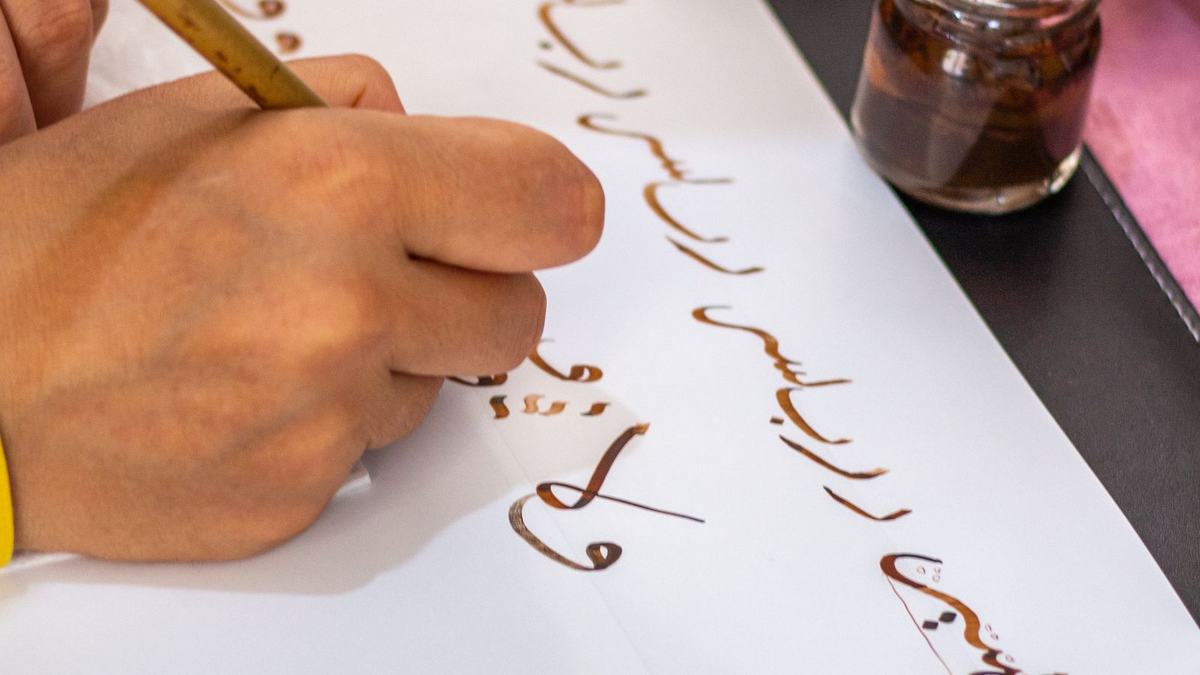
A new view of an ongoing exhibition
The biennial began on 7 October; the current development is the detailed account of Thursday’s exhibition visit, rather than a new opening. Mohammed Ibrahim Al Qaseer, who directs the biennial and the Department of Culture’s cultural affairs department, accompanied Tunisia’s acting consul general Mohammed Wael Al Khamassi around Calligraphy Square. Their route provides a useful snapshot of what is being shown during the programme’s final part.
The account identifies exhibitions devoted to Ali Al Hammadi from the UAE, Khalifa Al Shimi from Egypt and Baleid Hamidi from Morocco. Their works and personal collections offer a way to consider individual artistic practice within a shared tradition. For a visitor, the interesting comparison is how each practitioner organises a letter, a line or a composition while working within a field that depends on proportion and disciplined observation.
Another stop was My Family, My Paradise, presented at the Emirates Fine Arts Society for Arabic Calligraphy and Islamic Ornamentation with works by 11 Emirati artists. The family-centred title gives a different point of entry from the honouree collections. It allows a visit to move between individual artistic legacies and a group exhibition, creating an opportunity to ask how a familiar social subject is handled through distinct visual decisions.
Reading the theme through the work
The organiser’s account of the twelfth edition describes balance through the relationships between form and surrounding space. This is a useful instruction for looking. Begin with the overall arrangement before attempting to read every word. Notice where the composition is dense, where it opens and how the eye is directed between those areas. A visitor with limited Arabic can still attend to those visible decisions while seeking help with a text’s meaning.
Then return to the lettering itself. Repetition, changes of scale and the relationship between individual characters can give a composition its pace. Comparing two works with a similar amount of text may reveal very different uses of space. This is an observation exercise, not a substitute for the scholarship and training behind calligraphy, but it helps visitors move from a general impression of beauty towards a more precise account of what they see.
The 5 November delegation also observed a specialised Islamic ornamentation workshop involving students at the Sharjah Centre for Arabic Calligraphy and Ornamentation. Its presence is a reminder that the programme includes learning as well as finished displays. Visitors interested in taking part should consult the published programme for an activity’s actual availability and conditions. Seeing a workshop during an official tour does not establish that every session accepts unscheduled public participation.
Planning a route across the venues
Visit Sharjah lists Calligraphy Square, Sharjah Art Museum, House of Wisdom, the Emirates Fine Arts Society, 1971–Design Space and University of the Arts Sharjah among the biennial’s locations. It explicitly notes that opening times vary by programme and venue. Treat this as a distributed exhibition: choose the works or activities that matter most, confirm where they are shown and allow for movement between sites instead of expecting one building to contain everything.
Thursday’s reported route concentrated on Calligraphy Square in Heart of Sharjah, including the Calligraphy Museum, Ceramic House, the calligraphy centre and Dar Al Nadwa. That cluster is a practical starting point for a visitor whose main interest is calligraphy and ornamentation. The official tourism listing says venues can be reached by car or taxi, but individual arrival arrangements and walking distances should be checked against the places selected for a particular day.
For a short visit, a realistic sequence is to focus on a honouree exhibition and one contrasting group presentation, then leave time to compare them. Visitors with more time can follow the organiser’s general programme to additional venues and talks. Keeping the route selective is particularly useful for children or anyone who finds a long sequence of visually concentrated galleries tiring. A considered comparison often produces a stronger understanding than a hurried checklist.
The final days as a chance for close looking
The programme continues until 15 November, placing the 6–8 November weekend within its closing stretch. The event combines a general exhibition, solo shows, tributes, seminars, specialist screenings and workshops, according to the official tourism description. Those forms serve different purposes. A tribute offers sustained attention to a career; a group show brings different methods into proximity; a workshop exposes practice. Choose the format that fits the question you want the visit to answer.
For readers exploring Sharjah within a wider UAE journey, the guides below help connect cultural venues with their surrounding neighbourhoods. The biennial offers an especially specific reason to slow down in that setting: letters can be read as language, but they can also be examined as structures occupying space. The latest tour has made that opportunity tangible through named artists, working places and a programme with a clearly stated closing date.
Bring one comparison away from the visit: two different uses of empty space, two treatments of the same kind of stroke or two approaches to a familiar subject. A precise remembered observation gives the exhibition a longer life than a general impression that every work was beautifully made.
Gabriel Nicolaev – CyGuru
Gabriel Nicolaev – CyGuru